Agentic engineering:
the discipline behind agents that work.
An AI agent is software that plans, uses tools, and completes multi-step work. Agentic engineering is everything that makes that software dependable in production: the architecture, the orchestration, the evals, the guardrails, the monitoring, and the handover. This page explains the discipline in plain terms, and when you actually need it.
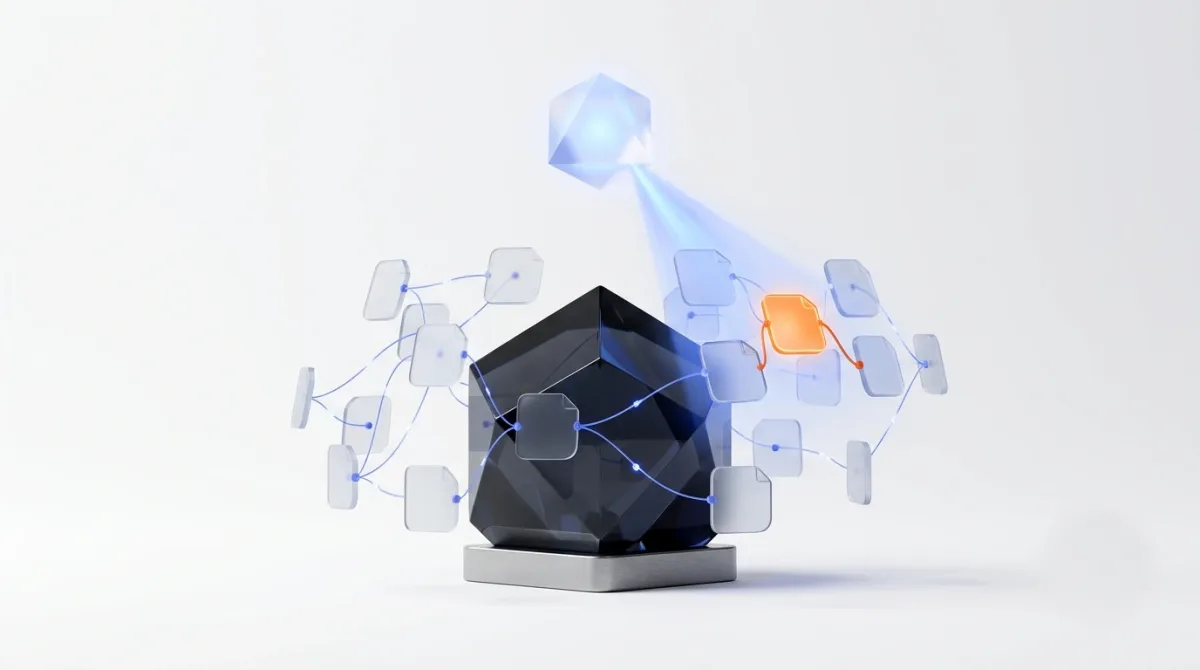

Using AI, automating with AI, engineering agentic systems
Level one is using AI: a person prompts a model (ChatGPT, Claude, a copilot) and judges every answer. The human is the quality control. It costs almost nothing to start and it is where every organization should begin, but the output only scales as fast as the people reviewing it.
Level two is automating with AI: a fixed workflow calls a model at one or two steps (classify this ticket, draft this reply, extract these fields). The path is deterministic; the model fills in one step. Most business problems that get labeled agentic actually live here, and a well-built workflow is cheaper, faster, and easier to test than an agent.
Level three is an agentic system: software that is given a goal, plans its own steps, chooses tools (search, database, email, code), and iterates until the work is done or a guardrail stops it. The autonomy is what creates the value, and the autonomy is exactly what makes engineering discipline non-negotiable: an agent that cannot be evaluated, bounded, or observed is a liability, not a workforce.
The model is the smallest part of the system
A production agent is maybe one-fifth model and prompt. The rest is the system around it: a typed contract for every tool the agent can call, an orchestration layer that decides what runs when and what happens on failure, retrieval that grounds the agent in your data, and fallbacks so the business keeps running when the model misbehaves or the provider has an outage.
Then come the parts that separate a demo from a system you can trust: evals (a graded test set that turns 'it seems to work' into a number you track on every change), guardrails on inputs and outputs with hard cost ceilings so a runaway loop cannot bankrupt the feature, and monitoring that watches quality, drift, hallucination rate, and spend in production, not just uptime.
What a production agent is made of
The model is one part. The system around it is what makes the agent dependable in production.
Six disciplines, one standard
Architecture: deciding where the agent's autonomy starts and stops, what stays deterministic, and how the agent fits your existing stack and security model. Orchestration: multi-step plans, tool routing, retries, and human-approval gates where the stakes require one. Evaluation: the graded test set is defined in phase one, so 'good' is a number we agreed on before anything ships.
Security: prompt-injection defenses and the OWASP LLM Top 10 alongside the classic OWASP Top 10, least-privilege tool access, and an audit trail for every action the agent takes. Monitoring: dashboards and alerts on quality, drift, and cost, tied to an on-call runbook. Business integration: the agent's work is measured in business terms (tickets resolved, hours saved, unit cost per task), so the ROI conversation is about numbers, not vibes.
Most tasks do not need an agent
The most valuable thing an agentic engineering partner can tell you is 'not here.' A deterministic workflow with one or two model calls beats an agent for most tasks: it is cheaper to run, easier to test, and simpler to explain to an auditor. We recommend agents where the work is genuinely multi-step and variable, the volume justifies the engineering, and the failure modes can be bounded.
That is why our audit scores use cases on value, risk, and effort before anything is built, and why the roadmap you get is vendor-portable. If the right answer is a workflow, a product you buy, or nothing at all, that is the recommendation you will get in writing.
One discipline, three offers
Training gets your teams fluent in what agents can and cannot do, with governance and the EU AI Act built in. Audit & Consulting applies the discipline as a decision: where agents are worth it, what it will take, and in what order. Build & Run applies it end to end: we design, build, and operate the system, then hand it over: code, evals, runbooks, and the operational knowledge to run it without us.
Three ways we help
Training, audit, and build & run: each moves you up the same ladder.
Agentic engineering: the questions buyers ask.
Direct answers to the questions we get asked the most. If yours isn't covered, write to the team.
Ready to apply the discipline to your operation?
Book a 30-minute call or start the intake. We will tell you honestly whether you need an agent, a workflow, or neither.